Logistics & Supply Chain
Saas & Cloud
8 Months
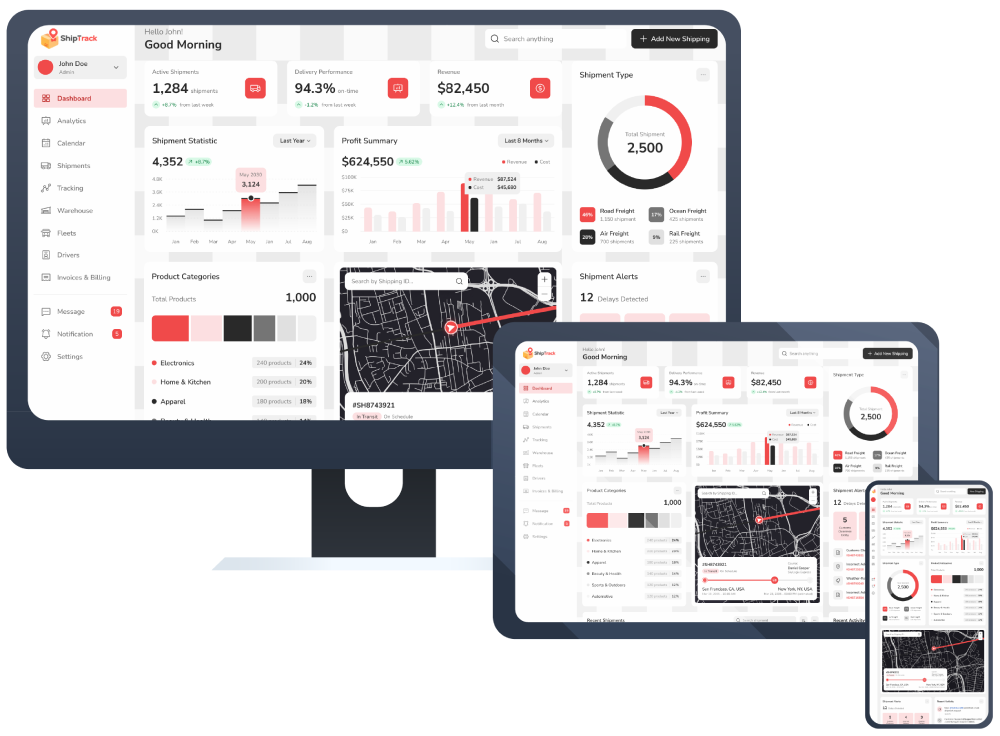
The logistics industry often struggles with fragmented data and delayed visibility. ShipTrack was conceived as a comprehensive digital solution to bridge the gap between physical cargo movement and real-time data monitoring. Developed with a focus on high-performance data processing and a seamless user experience, ShipTrack centralizes fleet management, warehouse operations, and multi-modal logistics into a single, unified interface. This case study explores the architectural journey of building a robust, scalable system capable of handling complex freight lifecycles from dispatch to final invoicing.
Developing a platform that synchronizes global logistics requires overcoming significant technical hurdles. The primary objective was to move away from legacy spreadsheets and manual entry toward an automated, fail-safe digital infrastructure.
Integrating data from disparate sources—GPS trackers on trucks, port authority APIs, and manual warehouse logs—into a cohesive stream was a major architectural bottleneck.
Maintaining a live dashboard that reflects instantaneous changes in shipment status and delivery performance without lagging or crashing under high concurrent loads.
Designing a backend flexible enough to calculate delivery metrics across diverse transit types (Air, Road, Rail, Ocean), each with unique time-scaling and routing logic.
Generating complex "Materialized Stats" (e.g., Average Delivery Time or Busy Periods) across millions of historical records without degrading the performance of the transactional database.
The development team focused on a modular architecture that separated intensive data processing from the user-facing interface, ensuring both speed and reliability.
We engineered a high-concurrency dashboard using WebSockets for real-time shipment alerts and state-of-the-art visualization libraries to render product categories and revenue stats instantly.
A centralized CRUD (Create, Read, Update, Delete) module was built to manage the triad of logistics: Warehouses, Fleets, and Drivers. This module includes automated conflict detection to prevent over-scheduling.
We implemented a rules-based engine that automatically generates invoices based on shipment weight, distance, and transit mode, reducing manual accounting errors by 90%.
To handle "Busy Period" and "Top Country" queries, we utilized materialized views and background worker processes that pre-calculate statistics, ensuring that heavy analytical data loads do not slow down the operational UI.
The system was built using a modern, full-stack approach designed for rapid iteration and high performance.
Since the deployment of ShipTrack, the system has transformed operational workflows. The development-first approach led to the following technical benchmarks:
administrative overhead for event managers.
faster than manual processing
During peak busy periods
Optimized for tracking queries
Beyond the code, ShipTrack provided the business with a "single source of truth." By centralizing fleet and warehouse management, the company achieved total transparency in their supply chain. The analytics module allowed leadership to pivot resources toward the "Top Country" for shipments based on real-time data rather than historical guesswork. Ultimately, the system reduced overhead costs and significantly boosted customer satisfaction through accurate, real-time delivery alerts.
Transform manual logistics into a high-performance, data-driven ecosystem with our React and Python expertise. From real-time tracking to automated billing, we build the tech that moves your business forward.
Let's Build Your Solution
HealthcareThis case study shows how we transformed messy paperwork into a fast, compliant system.
Explore success story
Hospitality & TourismStreamlining events with tiered ticketing, amenity mapping, and real-time inventory sync.
Explore success story
HealthcareScaling AI nutrition, wearable integration, and adaptive TDEE logic.
Explore success story